Bold eclectic interior design for Dubai apartments
Bold eclectic in Dubai uses saturated colour, mixed pattern, furniture from different eras and one statement anchor. A calm base and one or two repeated accents keep the room coherent. Start with art and furniture you already own, then spend on missing anchors and storage before adding more objects.
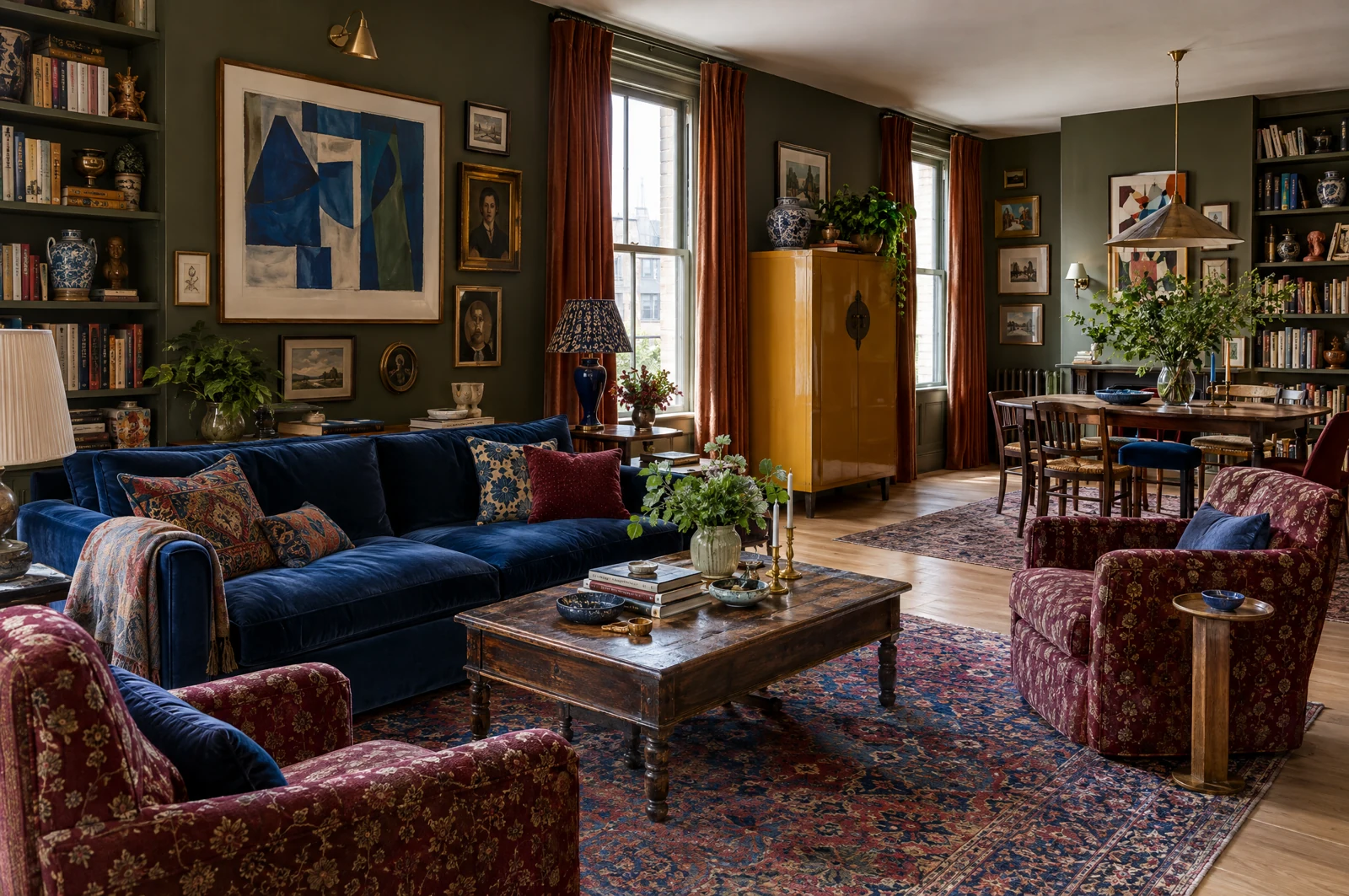
Bold eclectic is for people with things to say and things to show. It layers saturated colour, mixed pattern, and furniture from different eras with confidence (a gallery wall, a velvet statement chair, a bold rug) and what keeps it from tipping into chaos is discipline: a calm base and one or two accent colours that repeat until the whole room feels tied together. It's the least anonymous of the eight styles. No one else's apartment will look like yours.
The look, in short
The palette is confident but anchored: a calm base (a warm off-white or an inky navy) plus two or three repeating hues drawn from your taste. A common jewel-tone direction is emerald green, terracotta or rust, and mustard or teal, with brass or a plum jewel accent. The exact hues come from you; the discipline is that they repeat. Wood is mixed across eras and tones on purpose, because pieces are meant to differ. Metal mixes freely: brass, black, and more. Textiles carry the personality: velvet, ikat, kilim, block-print, embroidery, and global weaves, mixed within the anchor palette. Surfaces mix deliberately too: lacquer, marble, rattan, brass, tile.
The silhouettes are statements: a velvet or jewel-tone sofa, a contrasting vintage or global accent chair, a bold patterned rug as the room's anchor, mixed-era tables, and a gallery wall. Pattern and colour are features here, not faults, as long as the anchor holds.
Room by room in a Dubai apartment
Living room. Start with the anchor. A bold patterned rug or one dominant wall colour sets the palette, then a statement sofa (velvet in a jewel tone, or neutral with jewel cushions) anchors the seating. A contrasting accent chair from a different era sits opposite. Mixed-era side tables, a gallery wall of collected art, and one or two repeating accent colours across cushions and objects tie it all together. Lighting can be a statement in itself, like a brass or sculptural fixture. The through-line is the repeated accent, not matching furniture.
Dining. A confident table in marble, dark wood, or a bold colour, with mismatched-but-coordinated chairs, a patterned runner, and a statement pendant. A gallery of art or a single large piece on the wall. The palette repeats from the living room so the open-plan space, however layered, still reads as one home.
Bedroom. A statement headboard in velvet, colour, or pattern, layered bedding that mixes texture and one bold accent, and mismatched bedside pieces that coordinate through the palette. A gallery of smaller art, a patterned rug, and a jewel-tone lamp. Personality-forward but still restful because the anchor keeps it from shouting.
Bathroom and entryway. A patterned tile or wallpaper moment, a bold-framed mirror, a global-textured basket, and colourful art. Small doses of the same repeating accents.
Start with what you own
Photograph each piece you want to keep against a plain background and record its dimensions, dominant colours, material, condition and room. For art, include the frame size and a close photograph of the main colours.
Then build a simple inventory:
| Existing piece | Keep, repair or move | Colour to repeat | New piece it affects |
|---|---|---|---|
| Main artwork | Sofa or rug | ||
| Inherited chair | Side table and reading light | ||
| Existing rug | Sofa, curtain and wall colour | ||
| Cabinet or sideboard | Dining or media storage |
Choose one item as the colour source. Pull one dominant tone and one smaller accent from it. Repeat each in at least two places, while keeping the larger upholstery or walls calm enough to support them.
Add new furniture in a controlled order
- Place the existing anchors at real size on the plan.
- Choose the missing daily-use seating and storage.
- Select one rug or artwork as the pattern leader.
- Add lighting that supports the display and room use.
- Fill only the remaining gaps with smaller objects.
Build the budget in the same order: place the pieces you already own, fund the daily-use seating and storage, then add lighting, art and smaller objects.
Who bold eclectic suits
It suits people with things to display, a tolerance for colour, and no interest in a room that looks like anyone else's. It's the best style for building around inherited and collected pieces, and it rewards a bit of courage. It's a harder fit if you want calm, neutral, or pared-back. If you love colour and personality but want more warmth and a clearer period language, mid-century gives you retro accents inside a tidier frame; if your bold streak leans breezy rather than jewel-toned, coastal brings blue-and-white energy to a lighter base.
The Design Pack includes layouts, a linked shopping list, budget, furnished renders and an interactive walkthrough. HomePrint is design-only, so you buy directly from retailers. Send your floor plan, existing-piece photos and location for a scope and coverage check.
Frequently asked questions
How is bold eclectic different from just cluttered?
The difference is the anchor. Eclectic rooms feel collected because a calm wall colour or one dominant hue sits underneath, with one or two accent colours repeated around the room. Start with that structure, then add objects with a clear relationship to it.
Won't lots of colour date quickly?
Not if the bones are neutral. I keep the big, expensive pieces (the sofa, the rug's base, the walls) in tones that last, and put the boldest colour into things you can swap cheaply: cushions, art, a throw, a lamp. That way the room stays fresh and current, and you can shift the whole mood in a season without re-buying the furniture.
Can eclectic work with pieces I already own?
It's the best style for that. Eclectic actively wants inherited, vintage, and collected pieces: a chair from your grandmother, art you've gathered, a rug from a trip. I build the palette around what you're keeping so the new and the old sit together deliberately. Send me photos of what stays and I'll design the room to hold it.
Is it too much for a small apartment?
It can be, so in a small unit I keep the anchor calm and concentrate the boldness: one statement wall or one gallery, a single jewel-tone piece, and restraint everywhere else. Done that way it gives a compact Dubai apartment real personality without overwhelming it. The key is choosing where the drama lives rather than spreading it everywhere.